Mogadishu's civil-war devastation
Black Hawk DownMogadishu's civil-war devastation is more than a ruined backdrop to the October 3, 1993 raid: it shapes how the operation unfolds and exposes the civilians who bear its costs. Five years of conflict had left the port city scarred and its streets burdened by debris; when American forces entered the Bakara Market area, that damaged urban landscape became a place of combat, flight, injury, and grief. The narrative moves between the military mission and the lives of residents, showing a city whose wartime condition could not be separated from the violence taking place within it.
A city already damaged by war
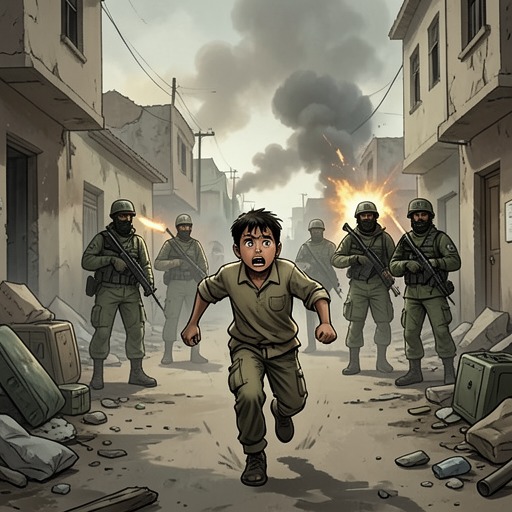
By the time American helicopters crossed Mogadishu, five years of civil war had reduced a once-picturesque port to a landscape of crumbling avenues, heaps of trash and debris, and buildings marked by bullets and cannon fire. The raid was directed at a gathering of Habr Gidir clan leaders associated with Mohamed Farrah Aidid. American forces planned to capture two of his lieutenants in the Bakara Market area, an Aidid stronghold; the daylight assault was a calculated risk in a neighborhood described as hostile to the operation.
The damage was also part of ordinary life beyond the immediate battlefield. Staff Sgt. Jeff Struecker, whose convoy was waiting to move toward the target, knew the city from repeated drives on water runs and other duties. He encountered garbage strewn through the streets, with people burning trash, tires, and animal dung for fuel. Residents spent time outside shabby huts and tin shacks; some men shook their fists as American vehicles passed. These details place the raid in a city already shaped by deprivation and antagonism, rather than in an empty combat zone.
The raid enters civilian space
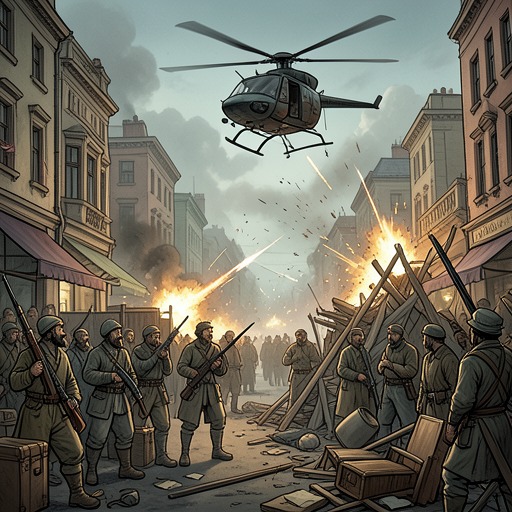
The operation brought a large force into the city in daylight: about 75 Rangers and 40 commandos traveled in 17 helicopters, while a 12-vehicle convoy waited to collect the assault force and Somali prisoners. The target was close to homes, shops, streets, and the Olympic Hotel. As the helicopters came in low, resident Abdiaziz Ali Aden saw one uproot a large tree in the courtyard of his stone house. After a helicopter was hit by an RPG and crashed into his home, part of the house collapsed over his parents and eight siblings. They were not badly hurt; Aden helped free them, and the family ran to a friend's house before he returned to guard the damaged property against looting.
The danger extended well beyond the crash. Ali Hassan Mohamed, a student who worked afternoons in his family's shop across Hawlwadig Road from the target house, saw Rangers descend on ropes and exchange fire with Somalis. His 15-year-old brother Abdulahi was killed by gunfire near the family home's gate. Ali fled through streets filled with terrified women and children, dead people and animals, and militia members calling on residents to defend their homes. He retrieved a hidden AK-47 and joined neighborhood friends in firing at the Rangers, moving between cover and the street despite their lack of combat experience. His account shows how the fighting drew residents into different, sometimes overlapping positions: civilians caught in immediate danger, local militia members defending their neighborhood, and people trying to escape.
Death, burial, and overwhelmed hospitals
The fighting disrupted movement across Mogadishu. Buses stopped, major roads were blocked, and gunfire and American helicopter activity made it difficult to carry wounded people to hospitals. Crowds gathered around the first crashed Black Hawk, and people moved through the streets seeking vengeance against the invading force. At the same time, the dead had to be buried. Kassim Sheik Mohamoud's two employees, mechanic Ismail Ahmed and accountant Ahmad Sheik, were killed when American helicopters opened fire on the garage where Somali militiamen were hiding. Kassim went to Digfer Hospital for safety, then returned as dusk approached to lead a burial party, in keeping with the obligation to bury the dead before sundown. At the cemetery, helicopters swooped close enough to make the party drop the bodies and flee; they returned to retrieve them, but another low pass drove them away again as they dug.
The medical burden grew as the fighting continued. At Volunteer Hospital, surgeon Abdi Mohamed Elmi had been treating wounded people since early the previous evening, although fear and burning roadblocks initially kept many from traveling for care. By the end of October 4, all 500 beds were expected to be occupied, with at least 200 additional wounded in the hallways; Digfer Hospital faced an even greater influx. Elmi worked through the night with six other surgeons in a three-bed operating theater and had assisted in 18 major surgeries by sunrise, while more patients continued to arrive. Delays left many people with gut wounds vulnerable to infections that the hospital's limited antibiotics could no longer successfully treat.
From urban devastation to political consequence
The city’s ruined streets intensified the consequences of the raid: they offered cover and obstacles, but they also held homes, shops, hospitals, and crowded public spaces in which civilians were exposed to the fighting. The account of the convoy’s return makes that exposure especially stark. One Ranger described shooting at young boys, some with weapons and some without, and firing into crowds where women ran alongside men carrying rifles. He felt numb and angry, intent on bringing his friends back alive. Near the airport gate, the convoy entered streets where people were moving through open-air markets as though nothing had happened; the contrast between ordinary activity and the battered vehicles carrying dead, wounded, and traumatized soldiers did not erase the violence that had just passed through the city.
The consequences reached beyond the battlefield. On the day after the raid, Congress questioned why American soldiers were dying in Somalia, while the White House faced public anger over the operation and its losses. At a six-hour meeting on October 6, officials considered the deaths of 18 American soldiers, the 73 wounded, the hundreds of Somali dead, and the capture of Michael Durant. Although military commanders believed Aidid had been weakened and that his supporters were retreating or offering peace feelers, the political appetite for continuing the pursuit had collapsed. The decision was to withdraw American forces by March 1994 and end efforts to capture Aidid. In this way, the devastation of Mogadishu registers simultaneously as physical ruin, civilian suffering, a humanitarian emergency, and a limit imposed on American policy.